
How to Scale Enamel Pin Production from 100 to 10,000 Units
A practical manufacturing guide for growing your pin business — from first test runs to high-volume production, with actionable advice on costs, quality control, packaging, inventory, and supply-chain planning. Learn exactly how many enamel pins you should order at each stage to minimize risk.
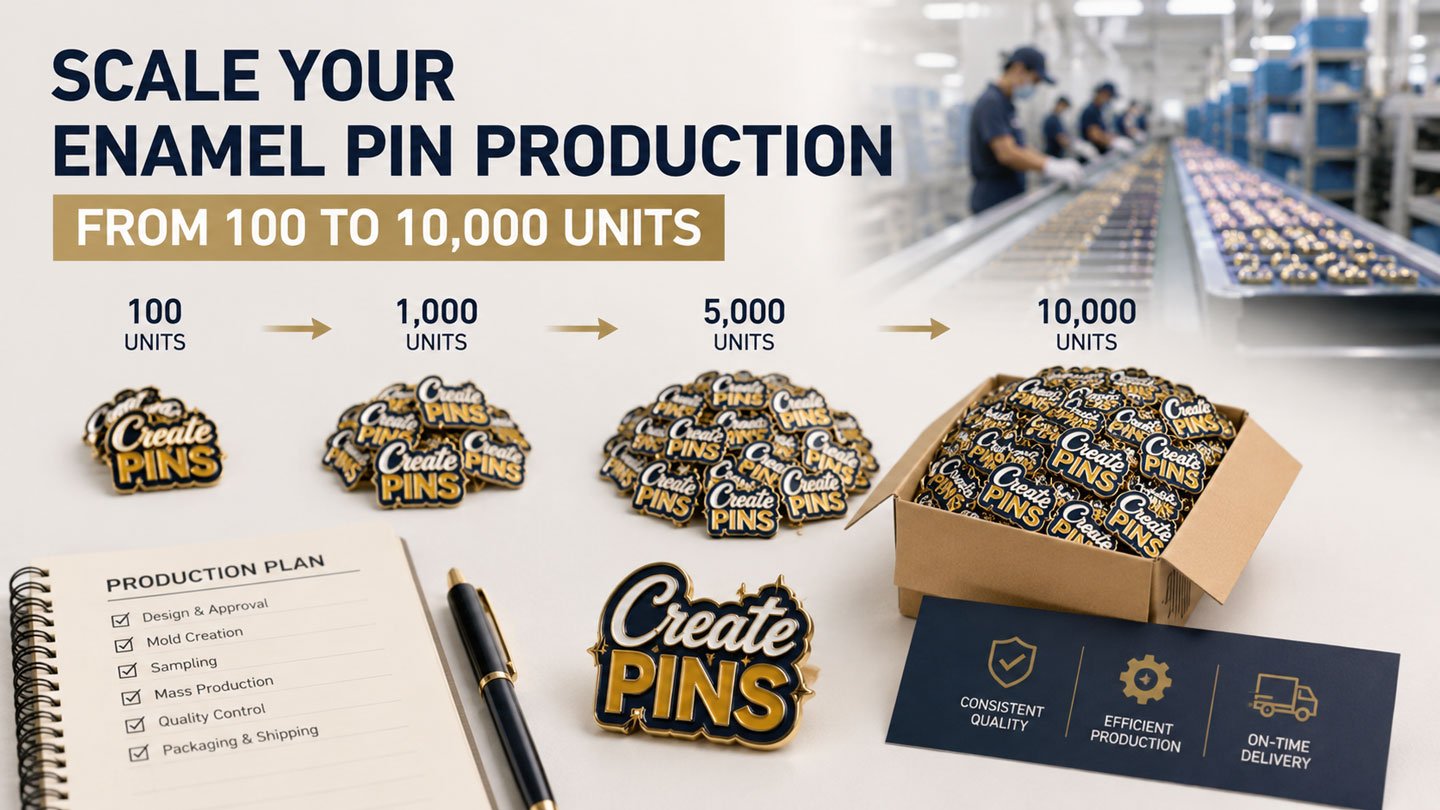
Deciding how many enamel pins should I order to start scaling production sounds simple:
100 pins → 500 → 1,000 → 5,000 → 10,000.
But increasing your enamel pin production volume isn’t simply a matter of ordering more pins. As you look to scale enamel pin production, the rules change entirely.
At 100 units, you may be able to manage your enamel pin production almost entirely by yourself. At 10,000 units, small problems with artwork, quality control, packaging, inventory, shipping, or supplier communication can become expensive problems.
A successful production scale-up requires a different approach to enamel pin manufacturing.
You need to think about:
- Product specifications
- Manufacturing capacity for bulk enamel pins
- Unit costs
- Tooling
- Quality control
- Packaging
- Inventory
- Shipping
- Cash flow
- Reorder planning
- Production scheduling
- Defect management
This guide explains how to scale custom enamel pin production from 100 to 10,000 units while reducing unnecessary risk and maintaining consistent quality. Understanding how to scale enamel pin production is the key to sustainable growth.
Quick take: Scaling your enamel pin production isn’t about ordering more — it’s about building a repeatable system. Start with a small test run, document every specification, establish quality standards, and increase volume only when your sales data justifies it. Don’t let a lower unit price for bulk enamel pins trick you into overordering.
1. Scaling Production Is More Than Ordering More Pins
When you’re producing 100 pins, your main question might be:
“Can the factory make my design?”
When you’re producing 10,000 pins, the question becomes:
“Can the entire supply chain consistently produce, inspect, package, and deliver 10,000 units to the required standard?”
That’s a much bigger challenge in enamel pin manufacturing.
At higher quantities for bulk enamel pins, you need to control several variables simultaneously.
A simple way to think about the process of enamel pin production is:
Design → Tooling → Production → Quality Control → Packaging → Shipping → Inventory → Reorder
If any one of these stages fails, increasing the order quantity can multiply the problem.
For example, if a design has a production issue affecting 5% of a 100-piece order, you may have only a handful of defective units. At 10,000 pieces, the same 5% would represent 500 units.
Scaling means controlling the process of enamel pin production — not simply increasing the quantity.
2. Start With a Small Production Run
For a new enamel pin design, jumping directly to 10,000 units is rarely the safest approach. If you’re wondering how many enamel pins should I order, the answer is almost always less than you think at first.
A smaller order allows you to validate:
- Artwork
- Colors
- Pin size
- Plating
- Enamel type
- Backing
- Packaging
- Customer demand
- Selling price
- Production quality
A typical progression to scale enamel pin production might look like:
100 → 300 → 500 → 1,000 → 3,000 → 5,000 → 10,000
You don’t have to follow these exact quantities. The important principle is:
Scale after you have evidence that the product works.
3. Your First 100 Pins Are a Test
A 100-piece order should not only be viewed as inventory. It can be a manufacturing test for your enamel pin production.
Use the first production run to evaluate:
Product
- Is the size correct?
- Is the metal finish right?
- Are the enamel colors accurate?
- Is the artwork readable?
- Are the lines sufficiently defined?
Customer response
- Do customers like the design?
- Which designs sell fastest?
- What price can the market support?
- Are customers requesting different sizes or variants?
Operations
- How long does enamel pin production take?
- How long does shipping take?
- How many defective units are received?
- How long does inspection take?
- Is your packaging efficient?
Your first order should teach you how to make the next order better. This is the foundation of how to scale enamel pin production effectively.
4. Establish a Master Product Specification
Before increasing volume, create a master specification for each pin design. This is critical for enamel pin manufacturing at scale.
This document should contain the details that must remain consistent from one production run to the next.
Include:
- Product name
- Product code / SKU
- Finished size
- Enamel type
- Metal / plating finish
- Enamel colors
- Pantone or agreed color references
- Backing type
- Backing quantity
- Pin post position
- Packaging
- Backing card specifications
- Artwork version
- Approved production proof
- Quality requirements
For example:
SKU: CP-001
Size: 1.5″
Enamel: Soft enamel
Plating: Black nickel
Backing: Rubber clutch
Backing card: 90 × 54 mm
Packaging: Individual poly bag
The exact specifications will vary by product. The important thing is consistency for your enamel pin production.
5. Keep Your Artwork Organized
Scaling enamel pin production becomes much easier when your artwork files are organized.
For every design, maintain:
- Master artwork — your original editable file.
- Production artwork — the final vector artwork prepared for enamel pin manufacturing.
- Approved proof — the version you approved for production.
- Production specifications — the physical dimensions and manufacturing requirements.
- Version history — e.g., Design V1, Design V2, Final V3.
This prevents an expensive mistake: manufacturing thousands of bulk enamel pins from the wrong artwork.
6. Don’t Change the Design During a Large Production Run
Once you’ve approved production, avoid making unnecessary changes.
A small change to border thickness, lettering, color, size, plating, or shape can require new tooling or a new production setup.
If you’re ordering 10,000 units, confirm the final design carefully before production begins.
7. Understand How Quantity Affects Unit Cost
One of the biggest reasons businesses scale enamel pin production is lower unit cost, especially for bulk enamel pins.
Manufacturing contains both fixed and variable costs.
Fixed or setup-related costs
- Mold / tooling
- Artwork preparation
- Certain setup costs
Variable costs
- Metal
- Enamel
- Labor
- Packaging
- Individual components
- Shipping
When you increase quantity, fixed costs can be spread across more units.
For example:
100 pins
A $60 tooling cost represents $0.60 per pin before considering other costs.
10,000 pins
The same $60 represents only $0.006 per pin.
The actual pricing structure will vary by manufacturer, but the principle is important:
Higher quantities can significantly change your cost structure for enamel pin production.
8. Don’t Choose 10,000 Just Because the Unit Price Is Lower
A lower unit price for bulk enamel pins doesn’t automatically mean a better business decision.
Suppose:
1,000 pins = $1.20 each and 10,000 pins = $0.75 each
The 10,000-piece order looks attractive. But you have to purchase and store an additional 9,000 units.
Ask:
- How quickly will they sell?
- Where will you store them?
- Can you afford the upfront payment?
- What if demand falls?
- What if the design becomes outdated?
- What if you need to modify the design?
- How much will shipping cost?
- How much inventory will remain after six months?
Unit economics and inventory economics are different things when you scale enamel pin production.
9. Calculate Your Inventory Turnover
Before ordering thousands of pins, estimate your sales velocity. This is the most practical way to answer the question of how many enamel pins should I order.
For example, suppose you sell 250 pins per month.
A 10,000-piece order represents 40 months of inventory — before accounting for defective units, samples, promotional giveaways, or changes in demand.
If you instead sell 1,000 pins per month, 10,000 units represents approximately 10 months of inventory.
The appropriate order quantity depends heavily on your actual sales rate.
10. Consider Demand Before Scaling
Look at your historical sales data.
Track:
- Units sold per month
- Units sold per design
- Sales during promotions
- Seasonal demand
- Repeat customers
- Wholesale orders
- Preorders
- Kickstarter demand
Don’t base a 10,000-piece enamel pin production decision entirely on optimism. Base it on evidence whenever possible.
11. Kickstarter Can Change the Scaling Equation
Crowdfunding can make large enamel pin orders more predictable.
For example, if a campaign generates 6,000 confirmed backers, you may have much more confidence in your production quantity.
But don’t automatically order exactly the number of backers. You may need additional inventory for:
- Defective units
- Replacement shipments
- Lost packages
- Customer service
- Retail sales
- Future orders
Build an appropriate production buffer into your plan.
12. Plan for Defects
Every enamel pin manufacturing process has quality-control considerations.
Your goal isn’t necessarily to demand an unrealistic zero-defect process. Your goal is to establish:
- Acceptable quality standards
- Inspection procedures
- Defect classifications
- Replacement policies
- Communication procedures
Common enamel pin issues can include:
- Scratches
- Plating imperfections
- Enamel overfill
- Enamel underfill
- Uneven metal surfaces
- Color variation
- Misaligned components
- Bent posts
- Missing backings
- Packaging damage
The acceptable level should be discussed before production.
13. Create a Quality Standard Before Ordering Thousands
A useful quality-control document can divide issues into categories.
- Critical defects — issues that make the product unusable or significantly incorrect.
- Major defects — issues that substantially affect appearance or function.
- Minor defects — small cosmetic imperfections that may not significantly affect the product.
The exact acceptance criteria should be agreed with your manufacturer. This becomes particularly important as quantities increase in your enamel pin production.
14. Approve a Production Sample When Appropriate
If your project is large or technically complex, a physical sample can be extremely useful.
A sample allows you to evaluate:
- Size
- Color
- Plating
- Enamel filling
- Metal borders
- Artwork details
- Backing
- Overall appearance
For larger orders, discuss sampling options with your manufacturer before mass production. The goal is to catch problems before thousands of units are manufactured.
15. Use a “Golden Sample” for Large Orders
For recurring products, consider maintaining an approved physical reference sample.
This can become your golden sample. It represents the agreed production standard.
When a new production batch is made, the manufacturer and quality-control team can compare the production against the approved reference.
This can help reduce subjective arguments such as “It looks slightly different.” Instead, you can compare the production directly against an agreed physical reference.
16. Control Color Consistency
Color becomes increasingly important as enamel pin production volume increases.
A color that looks slightly different on one monitor can look significantly different between physical products if the production specification isn’t clear.
For important colors, provide an agreed reference such as:
- Pantone reference
- Approved physical sample
- Manufacturer-approved color reference
Remember that physical enamel colors may not perfectly reproduce every digital RGB or CMYK color. Your goal should be to establish a clear physical production target.
17. Don’t Change Suppliers During a Major Production Run
Switching factories in the middle of a large order can introduce additional variables.
Different manufacturers may have different:
- Plating results
- Enamel colors
- Metal thickness
- Tooling specifications
- Quality standards
- Packaging procedures
If you’re scaling from 1,000 to 10,000 units, consistency becomes increasingly important. Whenever possible, establish a reliable manufacturing relationship before committing to very large quantities of bulk enamel pins.
18. Consider Multiple Production Batches
You don’t necessarily need to manufacture all 10,000 units simultaneously.
Depending on your supplier and business requirements, you might consider 10,000 total units produced as 5,000 + 5,000 or another appropriate batch structure.
This can help with:
- Cash flow
- Inventory management
- Quality monitoring
- Storage
- Demand forecasting
However, batch production may affect pricing and scheduling. Discuss the options with your manufacturer before placing the order.
19. Plan Your Production Lead Time
Larger orders may require more planning.
Typical custom pin production involves several stages:
Artwork approval → Tooling → Sample/proof approval → Metal production → Enamel filling → Polishing/finishing → Inspection → Packaging → Shipping
A typical production timeline for many custom pin orders can be around 10–15 business days after proof approval, but actual timing varies by quantity, design complexity, factory workload, and production requirements.
Shipping is additional. For large orders, ask your manufacturer for a realistic production schedule rather than assuming that a 10,000-piece order will take the same time as a 100-piece order.
20. Leave Extra Time for Quality Control
Don’t plan your launch date around the factory’s final production day.
If production finishes Friday and your customers need the pins Monday, you’re taking unnecessary risk.
Build time into your schedule for:
- Factory inspection
- Your own inspection
- Repacking
- Shipping
- Customs where applicable
- Carrier delays
- Replacement planning
The larger the order, the more valuable a buffer becomes.
21. Packaging Becomes a Major Issue at 10,000 Units
Packaging may be a minor concern at 100 units. At 10,000 units, it becomes a significant operational process for your enamel pin production.
Suppose every pin requires:
- One backing card
- One poly bag
- One pin
- Two rubber clutches
That’s already tens of thousands of individual components.
Small inefficiencies become expensive.
For example: if packaging takes 30 seconds per unit:
10,000 × 30 seconds = 300,000 seconds ≈ 83 hours of labor.
Even a few seconds of improvement per unit can have a meaningful effect.
22. Standardize Your Packaging
For large quantities, create a packaging specification.
Define:
- Backing card size
- Bleed requirements
- Printing
- Pin placement
- Backing attachment
- Bag type
- Labeling
- Barcode / SKU
- Outer carton requirements
The important principle is to establish one approved specification.
23. Calculate Carton Quantities
Large orders require more than counting individual units.
Determine:
- Units per inner box
- Inner boxes per carton
- Carton dimensions
- Carton weight
- Total cartons
- Shipping method
- Warehouse requirements
This information becomes important for freight planning. At 100 units, shipping is easy to think about. At 10,000 units, logistics becomes part of the product cost.
24. Shipping Can Change Your Economics
Don’t compare factories based only on the pin unit price.
Calculate:
Product cost + Packaging + Shipping + Duties/taxes (where applicable) + Warehousing + Fulfillment = True landed cost
A factory with a slightly higher pin price may sometimes produce a better overall result if the complete supply chain is more efficient.
25. Decide Where Inventory Will Be Stored
Before ordering thousands of pins, determine where they will go.
Potential options include:
- Your home
- Office
- Studio
- Warehouse
- Third-party logistics provider
- Fulfillment center
Ten thousand small pins can occupy significant storage space once packaging and cartons are included. Don’t wait until the shipment arrives to figure this out.
26. Consider a 3PL for High-Volume Orders
If you’re selling directly to customers, a third-party logistics provider can handle:
- Storage
- Pick and pack
- Shipping
- Tracking
- Returns
- Inventory management
This becomes increasingly useful as order volume grows. At low volume, doing fulfillment yourself may be economical. At high volume, your time can become more valuable than the fulfillment cost.
27. Track Inventory by SKU
If you have multiple pin designs, don’t simply count “pins.” Track inventory by SKU.
| SKU | Design | Quantity |
|---|---|---|
| PIN-001 | Dragon | 2,500 |
| PIN-002 | Skull | 1,500 |
| PIN-003 | Moon | 5,000 |
| PIN-004 | Logo | 1,000 |
This makes reordering and forecasting much easier.
28. Don’t Treat All Designs the Same
Some designs sell much faster than others.
For example:
- Design A: 500 units/month
- Design B: 100 units/month
- Design C: 30 units/month
Ordering 10,000 units of each would be a mistake. Instead, use sales data to determine production quantities. Your best-selling design may justify large production runs. Your experimental designs may be better suited to smaller batches.
29. Build Reorder Points
You don’t want to wait until your inventory reaches zero before ordering again.
Suppose you sell 500 pins/month and your total manufacturing + shipping lead time is 6 weeks. You need enough inventory to cover that lead time plus a safety buffer.
Your reorder point should consider:
Average sales during lead time + safety stock
The exact formula depends on your business. The principle is simple: reorder before you run out.
30. Maintain Safety Stock
Unexpected events happen. You may experience:
- Higher-than-expected sales
- Production delays
- Shipping delays
- Lost inventory
- Damaged units
- Replacement requests
Keeping a reasonable safety stock can prevent a temporary problem from becoming an out-of-stock situation. The appropriate percentage depends on your sales pattern and lead time.
31. Separate Manufacturing Inventory From Sales Inventory
If you’re running a large pin business, it can be useful to think about inventory in categories:
- Available inventory — ready to sell.
- Reserved inventory — allocated to Kickstarter rewards, wholesale orders, retail partners, or events.
- Safety stock — held for unexpected demand or replacements.
- Damaged/defective inventory — removed from sellable stock.
This makes inventory reporting much more accurate.
32. Scaling Requires Better Communication
At 100 units, you may be able to manage everything through a few messages. At 10,000 units, communication needs to be structured.
Keep written records of:
- SKU
- Quantity
- Artwork version
- Specifications
- Approved proof
- Production schedule
- Packaging requirements
- Inspection requirements
- Shipping instructions
Avoid relying on scattered messages such as “Use the previous version.” Be specific. For example:
“Please manufacture using Production Artwork V4 approved on September 1.”
Clear communication prevents expensive misunderstandings.
33. Establish One Source of Truth
Your manufacturer should have one clearly identified final specification.
For example: PIN-001_FINAL_V4
Then make sure:
- Your sales team uses the same SKU.
- Your packaging uses the same SKU.
- Your warehouse uses the same SKU.
- Your manufacturer uses the same artwork.
- Your purchase order references the same version.
This becomes increasingly important as your business grows.
34. Watch for Artwork Changes Between Reorders
Suppose your original order used Version 2. Later, you update the design to Version 3. Then six months later you reorder.
If your manufacturer accidentally uses Version 2, you could receive thousands of incorrect products. Always identify the exact approved artwork version in your purchase documentation.
35. Mold and Tooling Become More Important as You Scale
If you’re producing the same pin repeatedly, the manufacturing tooling becomes an important business asset.
Clarify:
- Who owns the mold?
- Who stores it?
- How long is it retained?
- Can it be reused?
- What happens if it is damaged?
- Can it be transferred?
- Can another factory use it?
Don’t assume that paying a mold fee automatically means you own the physical tooling. Document the arrangement before committing to large-scale production.
36. Consider Design Standardization
If you have a collection of pins, standardizing certain elements can simplify production.
For example, you might standardize:
- Backing type
- Backing card dimensions
- Packaging
- Plating options
- Pin sizes
- SKU format
This can simplify purchasing, packaging, inventory, customer expectations, and warehouse operations. Your designs can still be unique while the operational system remains standardized.
37. Create a Quality-Control Inspection Process
At 10,000 units, you probably don’t want to inspect every product individually unless your business model requires it.
Instead, establish an appropriate inspection strategy. Depending on the order and your agreement, inspection may involve:
- Pre-production approval
- In-process checks
- Random sampling
- Final inspection
- Packaging inspection
- Carton inspection
For large commercial orders, discuss an appropriate inspection standard with your manufacturer or independent inspection provider.
38. Don’t Ignore Packaging Quality
A perfect pin can still arrive with scratched plating, bent posts, crushed backing cards, torn bags, or damaged boxes.
Packaging quality therefore becomes part of your product quality. At high volumes, test the complete packaging system — not just the pin.
39. Plan for Replacement Units
When selling thousands of products, customer service becomes part of production planning.
You may need replacement inventory for:
- Manufacturing defects
- Shipping damage
- Lost packages
- Missing components
- Incorrect orders
Don’t sell every last unit you receive. Keep an appropriate replacement reserve.
40. Calculate Your True Cost Per Sellable Pin
Your manufacturing quote isn’t necessarily your final cost.
Suppose you order 10,000 pins but after inspection you have 9,850 sellable pins. Your effective manufacturing cost per sellable unit is different from simply dividing the invoice by 10,000.
Consider:
- Production
- Packaging
- Shipping
- Duties/taxes where applicable
- Inspection
- Warehouse fees
- Fulfillment
- Payment processing
- Defective units
- Replacement inventory
This gives you a much more realistic picture of profitability.
41. Scale Your Production in Stages
A practical progression to scale enamel pin production might look like this:
Stage 1: 100–300 Units
Goal: Validate the product and figure out how many enamel pins should I order for initial testing.
- Design
- Quality
- Customer feedback
- Sales
Don’t optimize everything yet.
Stage 2: 500–1,000 Units
Goal: Establish repeatable enamel pin production.
- Stable specifications
- Packaging
- Reorder planning
- Cost reduction
- Supplier communication
Stage 3: 1,000–5,000 Units
Goal: Build a reliable supply chain for bulk enamel pins.
- Forecasting
- Quality control
- Inventory
- Freight
- Production scheduling
- Cash flow
Stage 4: 5,000–10,000+ Units
Goal: Operate at commercial scale for enamel pin manufacturing.
- Production capacity
- Formal quality standards
- Warehousing
- Fulfillment
- Multiple SKUs
- Reorder forecasting
- Supply-chain continuity
At this stage, enamel pin manufacturing becomes an operational system rather than a simple purchase.
42. How to Negotiate Better Pricing at Higher Quantities
When your order volume increases, ask your manufacturer for a quantity-based quotation.
For example: 100, 500, 1,000, 2,500, 5,000, 10,000 units.
Compare the complete cost rather than only the unit price.
Ask whether higher quantities affect:
- Unit price
- Mold/tooling costs
- Packaging
- Shipping
- Production scheduling
- Sampling
- Payment terms
You may discover that the most economical quantity for your enamel pin production isn’t necessarily 10,000.
43. Ask About Production Capacity
Before placing a large order, ask: “Can your factory produce this quantity within my required timeline?”
A manufacturer may be comfortable producing 500 pins but have a very different scheduling situation for 10,000.
Ask about:
- Current production capacity
- Estimated lead time
- Peak-season delays
- Material availability
- Quality-control procedures
- Shipping schedule
Don’t commit to a launch date before confirming the production schedule.
44. Avoid Last-Minute Large Orders
One of the most common scaling mistakes is waiting too long.
For example: “We need 10,000 pins in three weeks.”
This leaves very little room for artwork corrections, tooling, sampling, production, inspection, packaging, and shipping.
Large orders should be planned well before inventory is needed.
45. Use Forecasting Instead of Guessing
As your business grows, create a simple forecast.
Track:
Beginning inventory + New production − Sales − Reserved units − Defects/replacements = Ending inventory
Then estimate future demand. Even a simple spreadsheet can significantly improve your purchasing decisions.
46. What Changes When You Reach 10,000 Units?
At 100 units, you’re mainly buying a product. At 10,000 units, you’re managing a supply chain for bulk enamel pins.
100 Units
- Small inventory
- Simple packaging
- Basic QC
- Easy shipping
- Small cash commitment
- Few SKUs
- Informal communication
- Simple storage
- Occasional reorder
10,000 Units
- Significant inventory
- Packaging system
- Formal QC process
- Freight planning
- Large cash commitment
- Multiple SKUs possible
- Documented specifications
- Warehouse / 3PL may be needed
- Forecast-based purchasing
This is why scaling successfully requires more than negotiating a lower unit price for bulk enamel pins.
47. Common Scaling Mistakes
- Mistake 1: Ordering too much too early — lower unit cost for bulk enamel pins doesn’t help if the inventory doesn’t sell.
- Mistake 2: Ignoring cash flow — a profitable product can still create cash-flow problems if too much money is tied up in inventory.
- Mistake 3: No master specification — small production changes can accumulate over multiple orders.
- Mistake 4: No physical sample — large production can magnify design problems.
- Mistake 5: No quality standard — arguments about defects become more likely.
- Mistake 6: Poor artwork version control — thousands of incorrect products can result.
- Mistake 7: Ignoring packaging — packaging problems become expensive at high volume.
- Mistake 8: No inventory forecast — you can run out — or overstock.
- Mistake 9: Waiting until inventory is almost gone — production and shipping take time.
- Mistake 10: Choosing a supplier based only on unit price — reliability, quality, communication, and logistics also matter.
48. A 10,000-Piece Production Checklist
Before placing a large enamel pin order, confirm:
Product
- Final pin size approved
- Enamel type confirmed
- Plating confirmed
- Colors approved
- Backing confirmed
- Packaging confirmed
Artwork
- Final vector artwork approved
- Production version identified
- Artwork version documented
- Original artwork backed up
Tooling
- Mold ownership clarified
- Reorder rights understood
- Tooling storage confirmed
- Transfer rights understood
Quality
- Physical sample reviewed where appropriate
- Quality standards documented
- Defect expectations discussed
- Inspection process agreed
Production
- Quantity confirmed
- Production timeline confirmed
- Material availability confirmed
- Production schedule documented
Packaging
- Backing cards approved
- Bags approved
- Labels / SKUs confirmed
- Carton specifications confirmed
Logistics
- Shipping method confirmed
- Freight cost estimated
- Destination confirmed
- Storage arranged
- Fulfillment plan ready
Financial
- Total landed cost calculated
- Cash flow checked
- Expected selling price confirmed
- Profit margin calculated
- Safety stock planned
49. How CreatePins Supports Larger Production Runs
At CreatePins, we work with customers ranging from small first-time orders to larger commercial production projects. We understand how to scale enamel pin production effectively.
If you’re moving from 100 pins toward 1,000, 5,000, or 10,000 units, the production strategy should change as your volume increases.
Before placing a large order, our team can discuss factors such as:
- Pin size
- Enamel type
- Plating
- Artwork requirements
- Tooling
- Packaging
- Production quantity
- Sampling
- Quality expectations
- Shipping
For larger orders, planning these details before production begins can help reduce surprises later.
If you’re scaling a design that has already proven popular, provide your previous specifications or approved artwork whenever possible. This helps maintain consistency between production runs.
50. The Best Time to Plan Your 10,000-Piece Order Is Before You Need It
Scaling successfully is mostly about preparation.
Don’t wait until your online store says “Only 12 left!” to contact your manufacturer. By that point, you may already be too late.
Instead, monitor:
- Sales velocity
- Inventory levels
- Production lead time
- Shipping time
- Seasonal demand
- Supplier capacity
Then place your next order early enough to maintain a healthy inventory level.
Final Thoughts: Scale Production Without Losing Control
Going from 100 to 10,000 enamel pins is a major step. Understanding how to scale enamel pin production is the key to making that jump successfully.
The goal isn’t simply to get the lowest possible unit price for bulk enamel pins. The goal is to create a production system that can reliably deliver the right product at the right quality, cost, and time.
- Start small and learn how many enamel pins should I order for a test run.
- Validate your design.
- Document your specifications.
- Establish quality standards for your enamel pin manufacturing.
- Track your sales.
- Forecast inventory.
- Improve packaging.
- Plan logistics.
- Then increase production as your demand justifies it.
The most successful pin businesses don’t scale by simply ordering more. They scale by building a repeatable manufacturing process for enamel pin production.
100 units
Test — validate the product and gather feedback.
500 units
Validate — confirm repeatable production quality.
1,000 units
Optimize — refine costs, packaging, and lead time.
5,000 units
Systemize — build formal QC and forecasting.
10,000 units
Scale — operate as a commercial supply chain.
If your enamel pin business is growing, start planning the next production level before you run out of inventory.
The goal isn’t just to manufacture 10,000 pins. It’s to build a system capable of selling, storing, shipping, and replenishing 10,000 pins successfully.
Frequently Asked Questions
What’s the best quantity to start with for a new enamel pin design?
For a completely new design, starting with 100–300 units is often the safest approach. This allows you to validate the product, customer demand, and production quality without committing to a large inventory. You can then scale up based on actual sales data. This is the best way to learn how many enamel pins should I order initially.
How much should I order for a Kickstarter campaign?
Order enough to cover your backers plus a buffer for defects, replacements, lost packages, and future retail sales. A common rule of thumb is to add 5–10% to your backer count, but this varies depending on your campaign size and risk tolerance. This will help you scale enamel pin production confidently.
How do I know when to scale from 1,000 to 5,000 units?
Scale when your sales velocity justifies it. If you’re consistently selling through your 1,000-unit batch within a reasonable timeframe (e.g., 2–3 months) and you have the cash flow and storage to support a larger order, it may be time to move up. Knowing how many enamel pins should I order comes down to consistent sales data.
What’s the biggest mistake pin businesses make when scaling?
Ordering too much too early based on lower unit price, without validating demand. Many businesses get excited about the cost savings at 10,000 units but end up with years of unsold inventory. Demand should drive your order quantity for bulk enamel pins — not the unit price.
Do I need a physical sample for a 10,000-piece order?
Strongly recommended. A physical sample allows you to catch design, color, plating, and quality issues before mass production begins. The cost of a sample is negligible compared to the cost of scrapping or reworking thousands of defective pins. It’s a vital step in how to scale enamel pin production safely.
How long does a 10,000-piece enamel pin order take?
Typical production lead time for custom enamel pins is around 10–15 business days after proof approval, but larger orders may require additional time. Always confirm with your manufacturer and build in extra buffer for inspection, packaging, and shipping.
Ready to Scale Your Enamel Pin Production?
Whether you’re moving from 100 to 1,000 or from 1,000 to 10,000 units, we can help you plan a production strategy that matches your demand and minimizes risk.